 = n·(n-1)·...·(n-k+1)
When k=n, nPk = n!
= n·(n-1)·...·(n-k+1)
When k=n, nPk = n!
= n·(n-1)·...·(n-k+1)
When k=n, nPk = n!
nPn, # permutations of all n of the things is n!
nPn-1 # permutations of n things taken n-1 at a time is also n!
nP1, # permutations of n things taken 1 at a time is n
nP2, # permutations of n things taken 2 at a time (ie. ordered pairs) is n(n-1) = #edges in fully-connected digraph
A multiset (elements can be repeated) # of permutations =
n! / m1!m2!...mi!
MISSISSIPPI = 11! / 1! 4! 4! 2! = 34650
MASSACHUSETTS =
Derangements all things "move", a complete rearrangement:
!n = ⌊n!/e + 1/2⌋
Probability of a permutation being a derangement is 1/e (in the limit as n→∞) ≈ 0.367879441
≈ 36.78% of permutations are derangements

| = | 
| n "choose" k | the binomial coefficients, Pascal's triangle |
nC0 =1, the empty set
nC1 =n, the singleton sets
nCn =1, the set itself
nCn-1 =n, each set minus one member
nC2 =(n(n-1))/2 =(n2-n)/2 = #unordered pairs = #edges in fully-connected graph Kn
nCk = nCn-k, symmetry
#combinations is the #permutations divided by k!: nCk = nPk/k!
#permutations is the #combinations multiplied by k!: nPk = nCk·k!
Combinations with replacement (i.e. repetition allowed).
#(unordered) samples with replacement.
nHk = n+k-1Ck = (n+k-1)! / (n-1)!k!


Binomial theorem:


#(unordered) samples without replacement = #subsets = #combinations = C(N,n) = N! / (N-n)!n!
N=100, n=10 C(100,10)≈17.3T
#(unordered) samples with replacement = #combinations with replacement = C(N+n-1,n) = C(N+n-1,N-1)
N=100, n=10 C(109,10)=C(109,99)≈42.6T
Probability that a sample selected with replacement of size n from a population
of size N has no duplicates (i.e. is a subset) is
N!/(N-n)!Nn = N·(N-1)·...·(N-n+1) / Nn
= Product(k=1 to n-1)(1-k/N)
| N | n: | 10 | 30 | 100 |
|---|---|---|---|---|
| 1000 | P(no dups) | 0.955861 | 0.644461 | 0.005959 |
| 10000 | P(no dups) | 0.995509 | 0.957392 | 0.608566 |
| 100,000 | P(no dups) | 0.999550 | 0.995659 | 0.951690 |
| 1,000,000 | P(no dups) | 0.999955 | 0.999565 | 0.995062 |
#ordered samples (permutations with replacement) = Nn
N=100, n=10 P(100,10)=100E (100 quintillion)
An element of an n-set is in half (2n-1) of all (2n) subsets.
So the probability that it is in a randomly chosen subset is ½.

So the probability that it is in two randomly chosen subsets is 1/4.
and the probability that it is in neither of the two subsets is 3/4.
Same for each of the n elements, thus the probability that two subsets
are disjoint is (3/4)n.


Probability that two k-sized subsets are disjoint is
n-kCk / nCk
Ex. set {a,b,c} n=3.
Partitions of k=1: {a,b,c}. S(3,1)=1
Partitions of k=2: {a,b}{c}, {a,c}{b}, {b,c}{a}. S(3,2)=3
Partitions of k=3: {a}{b}{c}. S(3,3)=1
Ex. set {a,b,c,d} n=4.
Partitions of k=1: {a,b,c,d}. S(4,1)=1
Partitions of k=2: {a,b}{c,d}, {a,c}{b,d}, {a,d}{b,c}, {a,b,c}{d}, {a,b,d}{c}, {a,c,d}{b}, {b,c,d}{a}.
S(4,2)=7
Partitions of k=3: {a,b}{c}{d}, {a,c}{b}{d}, {a,d}{b}{c}, {b,c}{a}{d}, {b,d}{a}{c}, {c,d}{a}{b}.
S(4,3)=6
Partitions of k=4: {a}{b}{c}{d}. S(4,4)=1
S(n,1)=1 S(n,n)=1
S(n,k) =  easy for software...No simple formula for us.
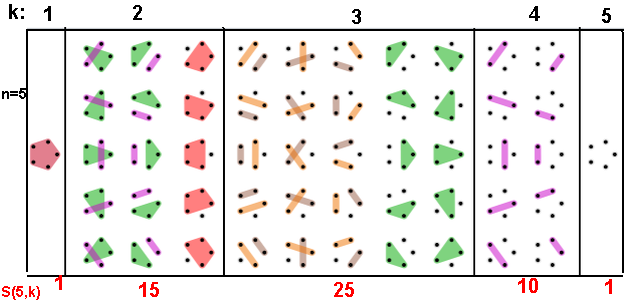
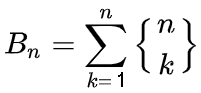
Total number of partitions of a set of size n is sum from k=1 to n of S(n,k)
= Bn (Nth Bell number).
Ex. set of size n=4: B4 = S(4,1)+S(4,2)+S(4,3)+S(4,4) = 1+7+6+1 = 15
| n | 1 | 2 | 3 | 4 | 5 | 6 | 7 | 8 | 9 | 10 | ... |
|---|---|---|---|---|---|---|---|---|---|---|---|
| Bn | 1 | 2 | 5 | 15 | 52 | 203 | 887 | 4140 | 21147 | 115975 |
Bell's triangle.
Copy end of row to start of next row.
Row entries are sum of entry to left plus entry left and above
(Mij←Mij-1+Mi-1j-1.
Rightmost entry is Bn.
| 1 | |||||||
|---|---|---|---|---|---|---|---|